
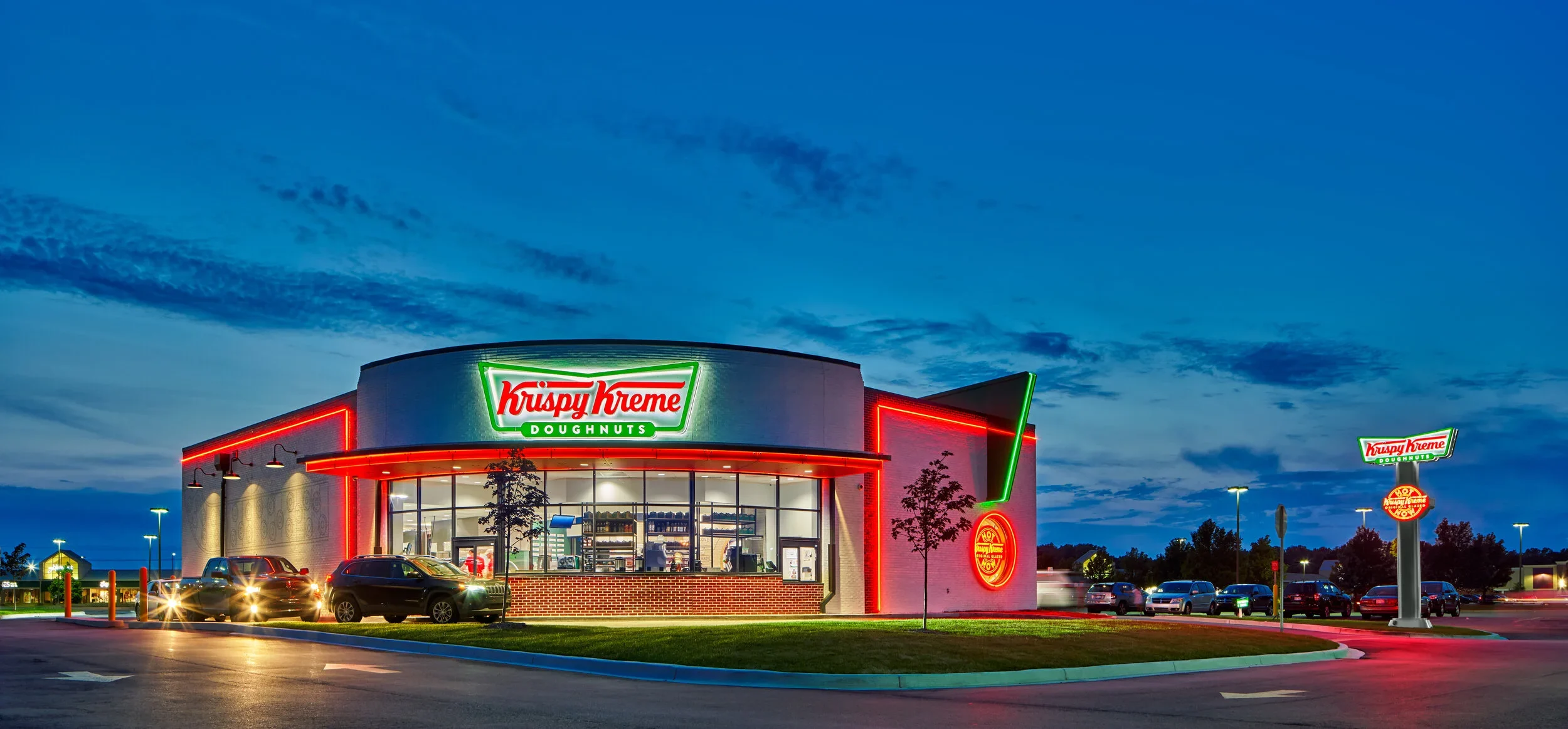
Choose the Right Format for Your Market.
Krispy Kreme development can take shape through several shop formats, each designed to fit different markets, locations, and development strategies.
One Brand. Multiple Development Paths.
Format selection depends on market characteristics, available real estate, production requirements, customer traffic, and the approved development strategy. Prospective partners can discuss the appropriate format as part of the formal franchise development process.
Hot Light Theater Shop
The full Krispy Kreme experience — a destination format built around on-site doughnut production and a customer-facing retail environment.
Format Highlights
- On-site doughnut production and Hot Light signage
- Large-format retail and customer experience area
- Designed for high-visibility, high-traffic locations
- Supports dine-in, takeaway, and drive-thru options
- Ideal for flagship markets and major metropolitan areas
Best Suited For
Markets with strong consumer demand, premium real estate availability, and development partners able to operate a full-format production and retail location.
Fresh Shop
A streamlined retail format designed for selected markets where a compact, accessible shop model supports the local development strategy.
Format Highlights
- Compact retail footprint with fresh doughnut delivery
- Efficient operating model for high-footfall locations
- Suited to shopping centres, high streets, and transport hubs
- Focus on takeaway, gifting, and coffee pairing
- Faster build-out and lower capital requirement than full format
Best Suited For
Markets with strong retail traffic, limited real estate availability, or development partners seeking a scalable entry point into the brand.
Box Shop
A compact development concept suited to selected locations and distribution-led market strategies, with a focus on convenience and accessibility.
Format Highlights
- Small-footprint format for high-traffic environments
- Focus on takeaway doughnuts and packaged boxes
- Suited to airports, transit hubs, and event venues
- Low capital requirement and fast deployment
- Can complement other formats within a territory
Best Suited For
Development partners looking for a capital-efficient entry format, or markets where traditional retail footprints are limited or prohibitively expensive.
Non-Traditional Formats
Selected non-traditional formats may be considered where market conditions, partnerships, or location opportunities support a flexible development approach.
Format Highlights
- Partnerships with retail, fuel, and convenience operators
- Pop-up, kiosk, and in-store shop-in-shop concepts
- Event, stadium, and travel-hub activations
- Designed around local market requirements and demand
- Evaluated case-by-case as part of the development plan
Best Suited For
Markets where traditional shop formats are not immediately viable, or where strategic partnerships can extend brand reach and consumer access.
Compare Format Characteristics
A high-level comparison of the main format characteristics. Detailed format requirements are reviewed during the formal development process.
| Format | Footprint | Production | Typical Locations | Capital Level |
|---|---|---|---|---|
| Hot Light Theater | Large | On-site | Flagship metros, high-visibility sites | Higher |
| Fresh Shop | Medium | Delivered | Shopping centres, high streets, transit | Medium |
| Box Shop | Small | Delivered | Airports, transit hubs, event venues | Lower |
| Non-Traditional | Variable | Variable | Partnerships, pop-ups, travel hubs | Variable |
How the Right Format Is Determined
The appropriate format for a market is determined through a structured review of the territory, the partner, and the development strategy.
-
Market & Territory
Population, consumer demand, competitive landscape, and geographic coverage all influence the format that makes sense for a given market.
-
Real Estate & Locations
Available sites, anchor destinations, traffic patterns, and lease conditions shape the choice of footprint and production model.
-
Partner Capability
Operating experience, financial capacity, and management resources are considered alongside the proposed format and rollout plan.
-
Development Strategy
The number of locations, rollout timeline, and mix of formats are agreed as part of the development planning process.
Discuss the Right Format for Your Market
Format selection is part of the formal franchise development process. Begin your application to start the conversation.
Begin Your Application